Policy Breakdown
How is the Federal Government Funded?
Each year, the federal government takes in trillions of dollars in revenue and spends even more on programs and services. Elected officials decide what to fund through a complex process of rules, bills, and deadlines — known as the budget and appropriations process. Check out this primer to learn how the process works, the challenges it creates, and how it impacts you.

Key Terms For Reading This Primer
If you’ve never heard the words “budget and appropriations” before, don’t worry. You’re not alone. Here are seven key terms that will be helpful to know now as you read this primer.
- Federal Budget: How much money the government spends and takes in each year. It includes discretionary spending, mandatory spending, and revenue.
- Appropriations: Legislation that provides the government with the authority to spend money.
- Fiscal Year: The period that the federal government budgets for each year.
- President’s Budget: The proposed budget that the White House submits to Congress for the upcoming fiscal year.
- Budget Resolution: A blueprint passed by Congress setting spending and revenue goals for the upcoming fiscal year.
- Appropriations Process: The annual passing of bills that fund discretionary spending.
- Continuing Resolution: A bill that temporarily funds the government for a limited period of time.

What Is The Budget And Appropriations Process?
The budget and appropriations process is essentially the standard operating procedure for funding the federal government.
The federal government has to plan its spending and revenue each year and does so through the budget and appropriations process. It involves a complex web of rules, bills, and deadlines, and it relies on a Congress that is functional. And even when it plays out on time, it takes almost an entire year. To understand this process — and how it got so complicated — let’s start from the beginning.
Origin
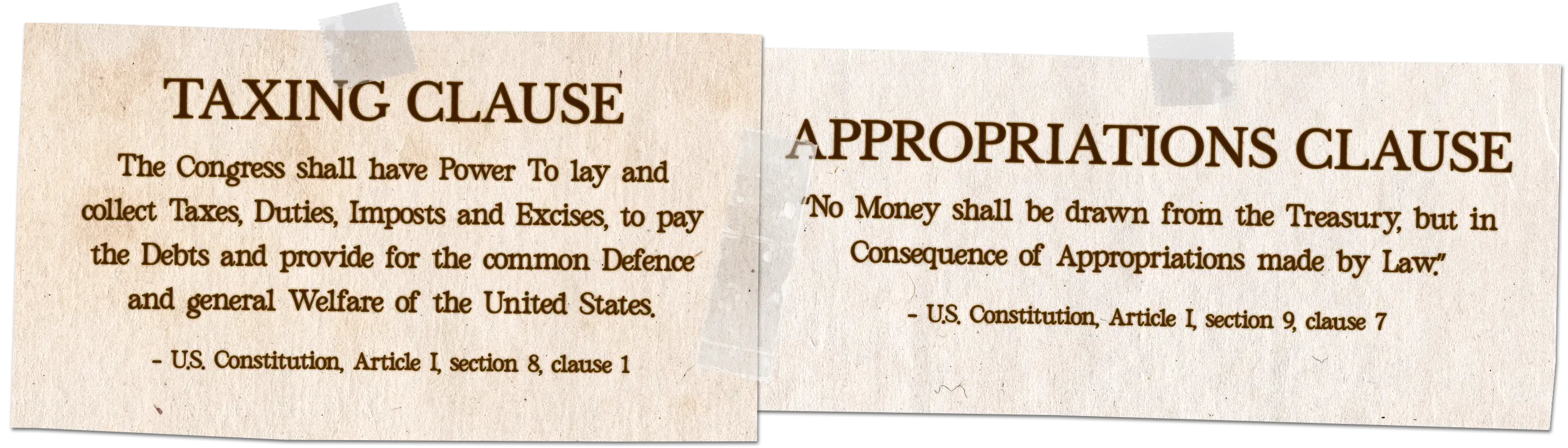
Believe it or not, the budget and appropriations process goes all the way back to our country’s founding and is in Article I of the Constitution of the United States. To repay Revolutionary War debts and provide basic services to the American people, the newly formed government needed a system for imposing taxes and authorizing new spending.
The Constitution created one through the Taxing Clause and Appropriations Clause, which gave Congress the power to:
- Impose taxes to collect revenue, and
- Authorize spending to pay its debts and provide basic services.
This gave Congress “the power of the purse.”
Although the Constitution established a general framework, it left it to Congress to determine the specific process for making those decisions.
Everything was relatively simple at first. In fact, the House and Senate only needed to pass two bills for the first federal budget.
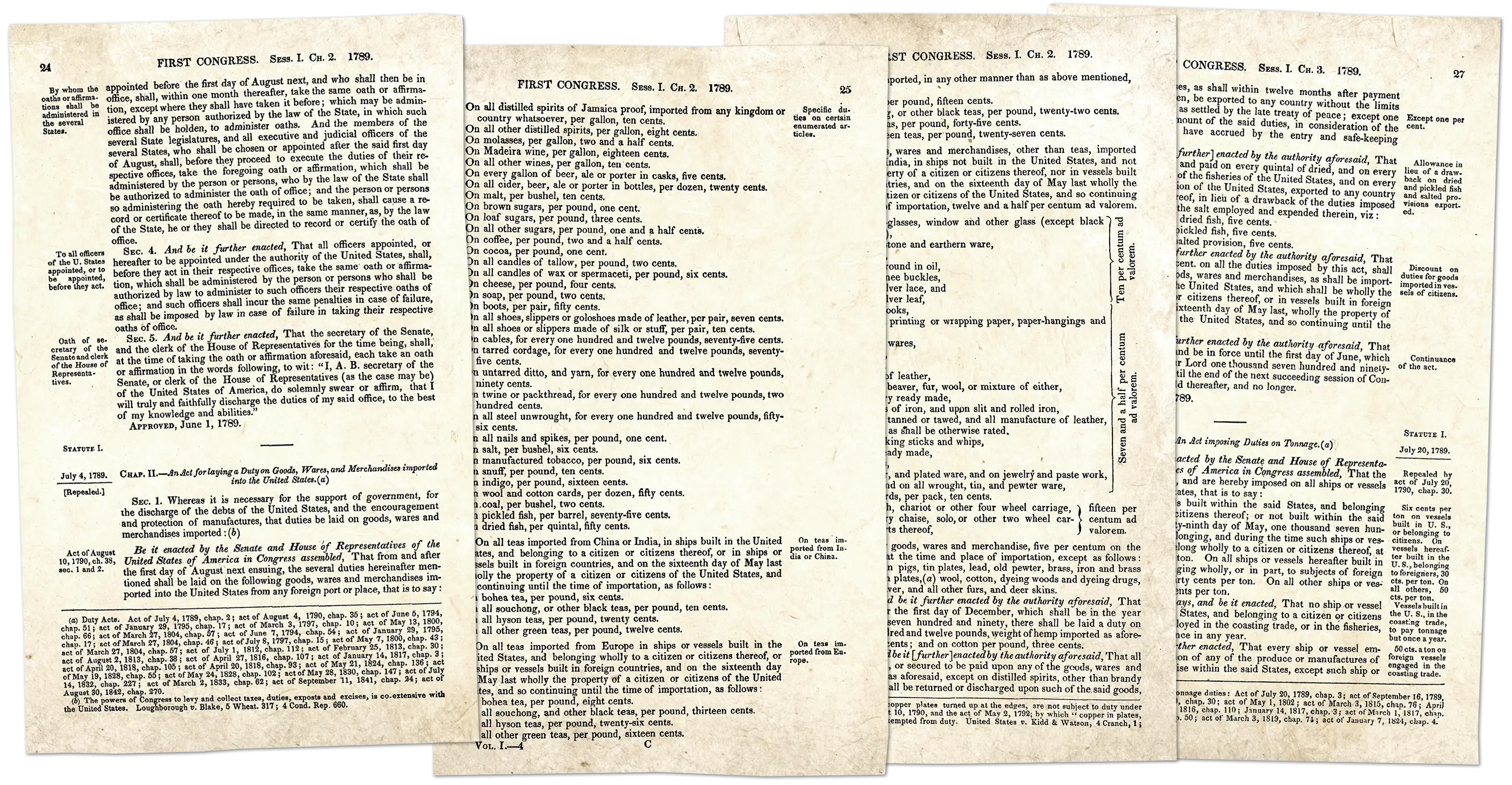
1. A tariff revenue bill was signed into law on July 4, 1789, to fund the government and pay down its debt.
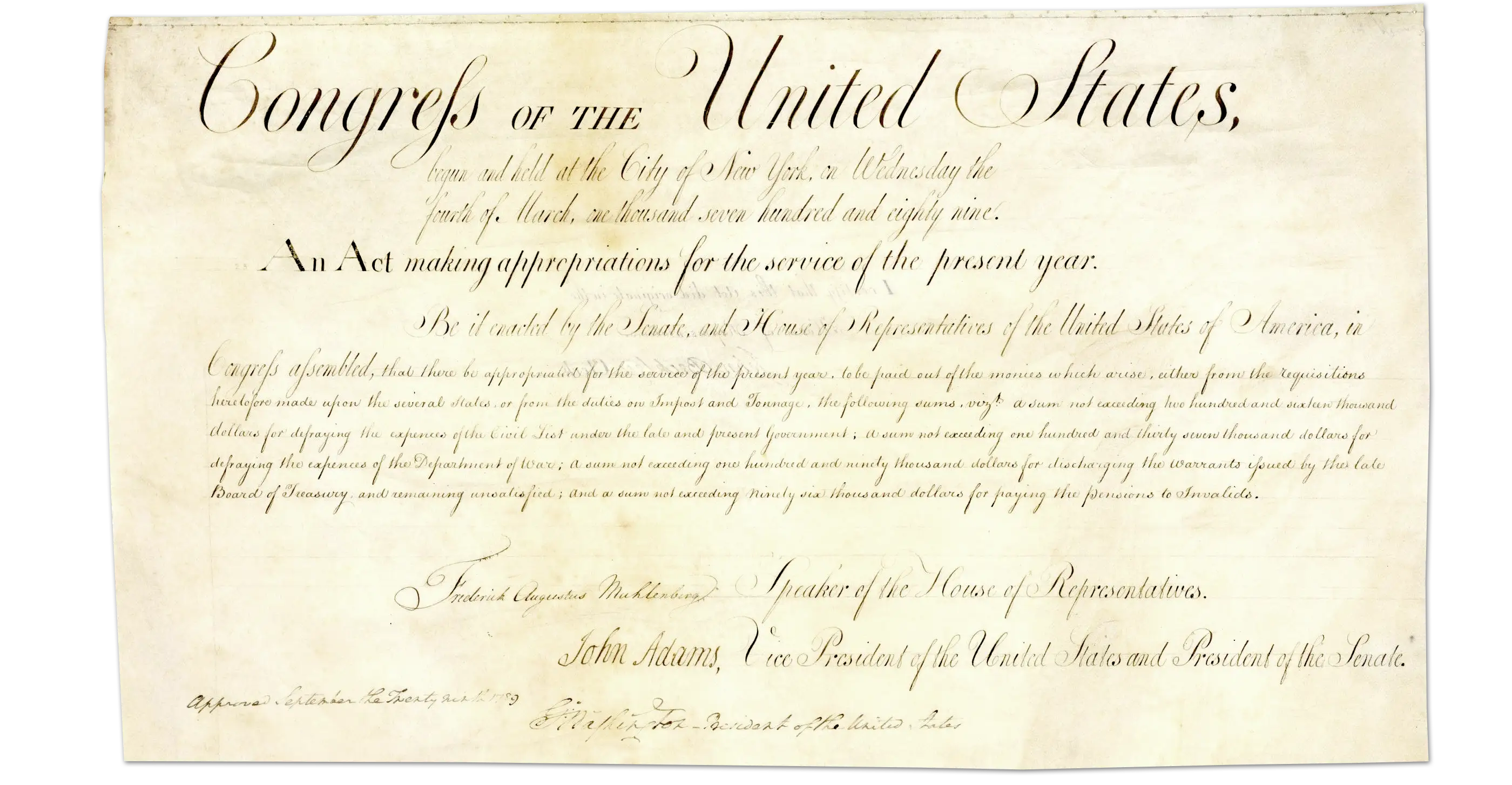
2. A single appropriations bill was signed into law on September 29, 1789.
Then as the country grew, the process started to involve more steps, legislation, and people.
The Current Budget Process
Here’s what the process looks like today:
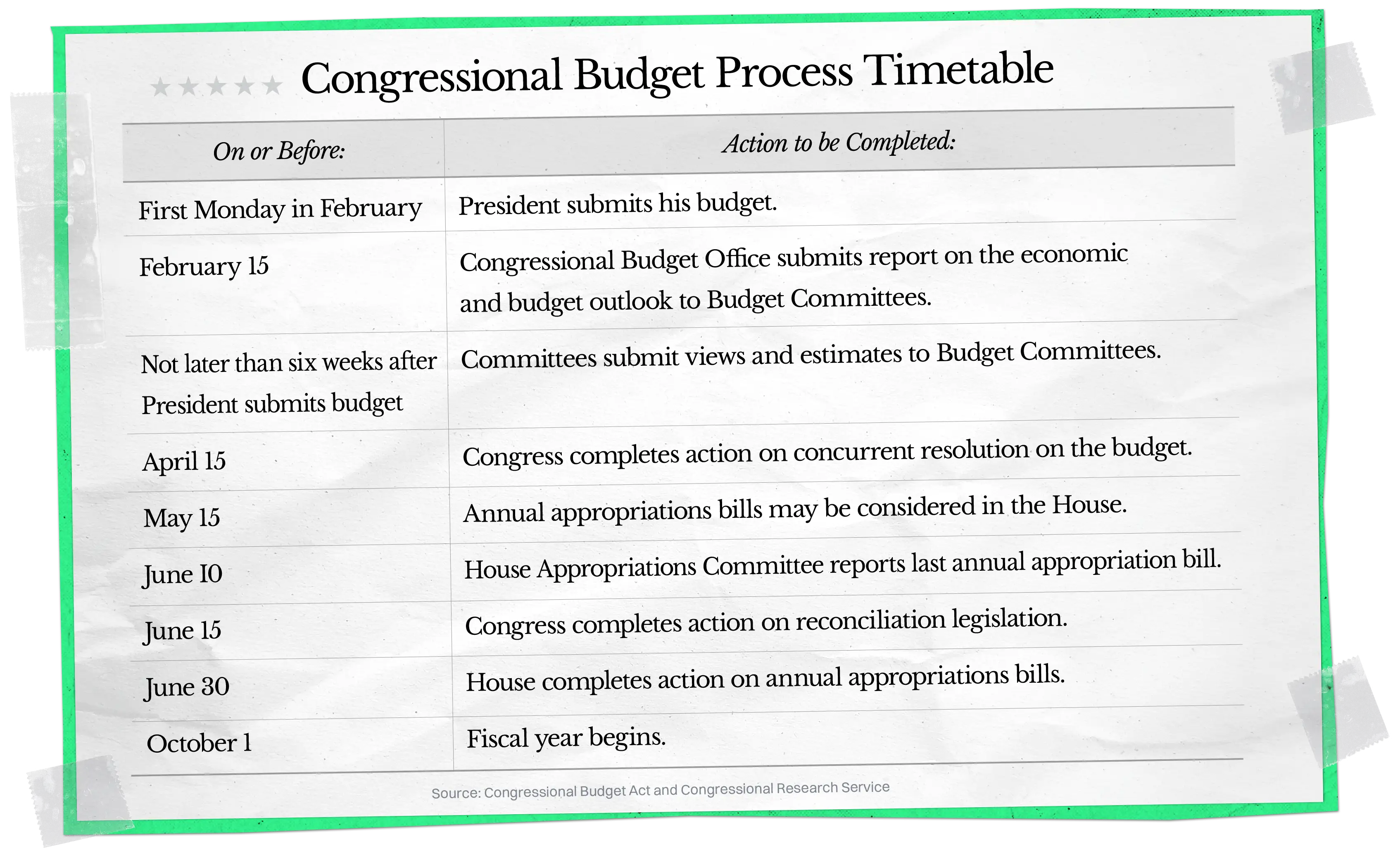
Seems more complicated, huh? And that’s when things are running smoothly.
Before we dive into this process in greater detail, here are some basics about the federal budget.
The Federal Budget
Even though it is several trillion dollars, the federal budget is simply how much money the government plans to spend and take in each year. It is made up of three components:
- Discretionary spending is the money that Congress needs to decide on each year. It covers policy areas such as national defense, education, transportation, housing, and scientific research.
- Mandatory spending is the spending required by law to occur each year without action by Congress. It includes Social Security, Medicare, Medicaid, and interest on the national debt.
- Revenue is the money the government takes in to fund its programs and services. It primarily comes from taxes on individuals and corporations. Like mandatory spending, it is set by existing laws and doesn’t require further congressional action every year.
The Fiscal Year
When we talk about the federal budget, you’ll often hear the term “fiscal year” (FY).
For your personal budget, you might think about your income, spending, and financial goals from January to December — a.k.a. the calendar year. Meanwhile, the federal government budgets for a fiscal year, which is also a 12-month accounting period many businesses and governments use.
The U.S. fiscal year happens to run from October 1st of one year to September 30th of the next. Why, you ask? Well, originally they followed the calendar year, just like you. But Congress kept having to push its deadlines back to give itself more time to make budget decisions. So, in 1974, it passed the Congressional Budget Act. It established the current federal fiscal year, which became effective in 1976. This way, Congress wasn’t forced to pass a budget before its summer recess.
Now, if someone refers to fiscal year 2027, they’re talking about the period from October 1, 2026, to September 30, 2027.