
How It Works
To recap:
- The federal budget sets discretionary spending, mandatory spending, and revenue levels for each fiscal year.
- Spending is determined through the budget and appropriations process, which follows a set timeline every year.
- The executive and legislative branches each play a role in crafting and passing budget legislation.

This might seem straightforward, but the budget and appropriations process is actually pretty complicated. There’s a lot of behind-the-scenes work that goes into setting spending and revenue levels, and the way it’s supposed to work doesn’t always match what happens in practice.
Let’s start with how the process should work in five steps.
Step 1: The White House Submits a Budget Proposal

Congress may have “the power of the purse,” but the budget process actually starts in the executive branch.
First, each executive agency analyzes its budget needs and submits funding requests to the Office of Management and Budget (OMB), which oversees the president’s fiscal policy. Putting together an agency’s funding request takes months, and for some agencies, such as the Department of Defense, it can take a year. After considering each agency’s request, the OMB then puts together the President’s Budget.
This kickstarts the process by outlining the administration’s discretionary spending, mandatory spending, and revenue priorities for the upcoming fiscal year. The OMB is required to send the President’s Budget to Congress by the first Monday in February.
Step 2: Congress Sets Its Budget Goals
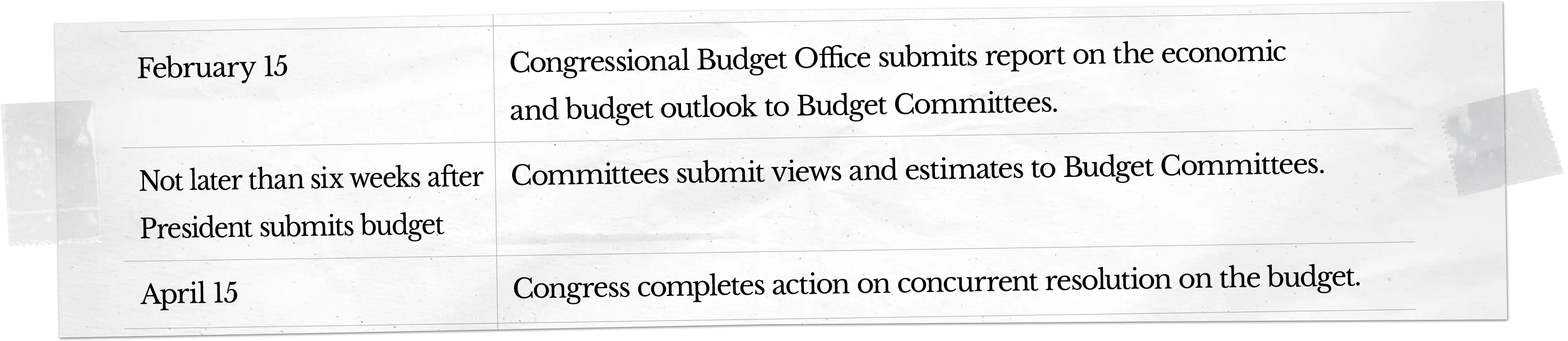
After reviewing the President’s Budget, the House and Senate Budget Committees hold hearings, where administration officials, members of Congress, and other experts discuss the White House’s spending and revenue requests. Based on these hearings, the committees put together their own budget targets and send them to their respective chambers for consideration.
By April 15th, the House and Senate are expected to reach consensus on one set of goals for discretionary spending, mandatory spending, and revenue for the upcoming fiscal year. This is called a concurrent resolution on the budget or a budget resolution.
Step 3: Appropriations Committees Draft Legislation

Once Congress decides on its spending goals, it starts the real work of passing its appropriations bills. This is when things can get really busy.
First, the House and Senate Appropriations Committees are responsible for developing and passing the 12 bills that set discretionary spending across the federal government. This is also a period where constituents, lobbyists, and other organizations can contact elected officials to advocate for funding for programs that are important to them.
After listening to these groups, members of Congress often make funding requests. Some of these requests support agencies and programs more broadly, but lawmakers can also direct specific funding to state or local projects — known as earmarks.
These earmarks are formally called Community Project Funding in the House and Congressionally Directed Spending in the Senate. They serve multiple purposes: They can be used by members to bring home tangible wins that secure support in future elections, or within Congress to reward individual members or incentivize their support for legislation. Earmarks ballooned in the late 2000s before being outlawed in 2011, but were reinstated in 2022.
Each Appropriations Committee has 12 subcommittees, which are smaller, specialized groups of lawmakers. They are responsible for drafting their respective appropriations bills, debating them, voting on them, and then sending them to the full committee for consideration. The subcommittees are named after the appropriations bill they are responsible for, which range from “Defense” to “Agriculture, Rural Development, Food and Drug Administration, and Related Agencies.”
The full committee then debates, edits, and votes on each bill. If the bill passes out of committee, it heads to the Chamber floor for consideration by either the full House or Senate.
Step 4: Congress Amends and Passes

All 12 appropriations bills may go through a round of revisions from the full Congress before becoming law. Here’s what’s supposed to happen for each one:
- Members review the legislation and propose amendments, which are debated.
- After debate, the chamber takes a vote, and amendments pass or fail.
- Once all amendments are addressed, the chamber votes on the final bill.
- If a bill receives enough votes to pass, it goes to the other chamber where they can either take up that legislation or propose their own spending package.
- This continues until majorities in both the House and Senate agree on the same appropriations bill.
This is all much easier said than done.
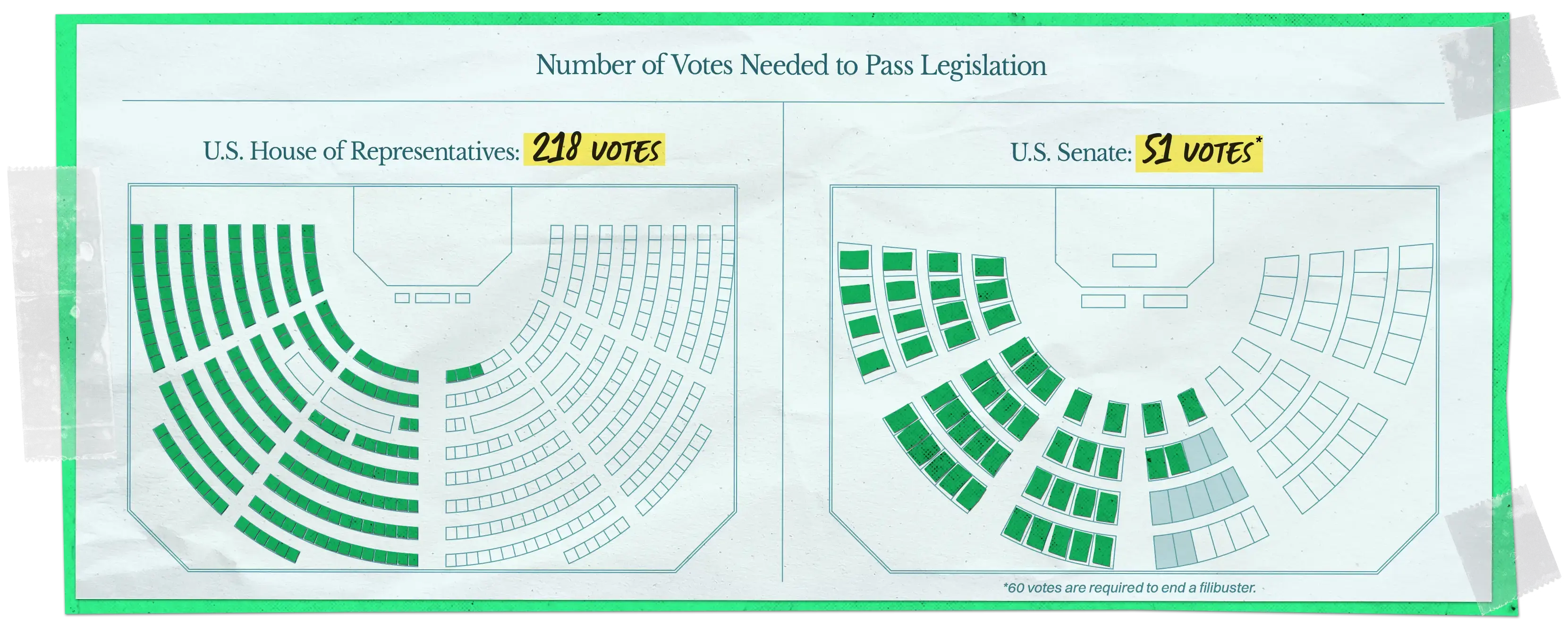
Why? Think about the size of Congress. There are 100 senators and 435 representatives involved. That’s a lot of cooks in the kitchen.
Step 5: The President Signs (Or Vetoes)

To ensure the government is funded by the beginning of the fiscal year, these appropriations bills must be signed into law before the next fiscal year begins on October 1st.
For that to happen, Congress must pass and send the appropriations bill to the President, who has 10 days to sign it into law or veto it. With a veto, the bill goes back to Congress, which can either override it with a two-thirds majority, or choose to submit a revised bill. If the President does nothing, the appropriations bill automatically becomes law after 10 days.

Mandatory Spending and Revenue
You might be wondering how mandatory spending and revenue fit into this process. Unlike discretionary spending, they are not set on a regular annual timeline. Changes to mandatory spending and revenue must still go through relevant congressional committees, be passed by both chambers of Congress, and eventually go to the President’s desk. But, Congress does not have to revisit and approve them each year by October 1st.
