
Challenges
To quickly review:
- Congress must fund the government before October 1st, the start of every fiscal year.
- Meeting that deadline in the manner Congress intended is only possible if lawmakers follow the five steps of the budget and appropriations process and are able to find consensus along the way.
Due to a deepening divide over fiscal policy and rising partisanship, this rarely happens. In fact, Congress has only fully funded the government before October 1st four times in the last 50 years. The last time was in 1996.
Yep, that means Gen Z has never even seen the budget and appropriations process play out on schedule in their lifetimes.
Here are the common pitfalls with each of those five steps that keep the budget process from running smoothly and effectively.
FIVE PITFALLS
The President’s Budget is Late
Remember, the White House is responsible for sending the President’s Budget proposal to Congress by the first Monday in February.
But here’s the catch: President after president has missed the deadline to submit their budget proposal, sometimes by months.
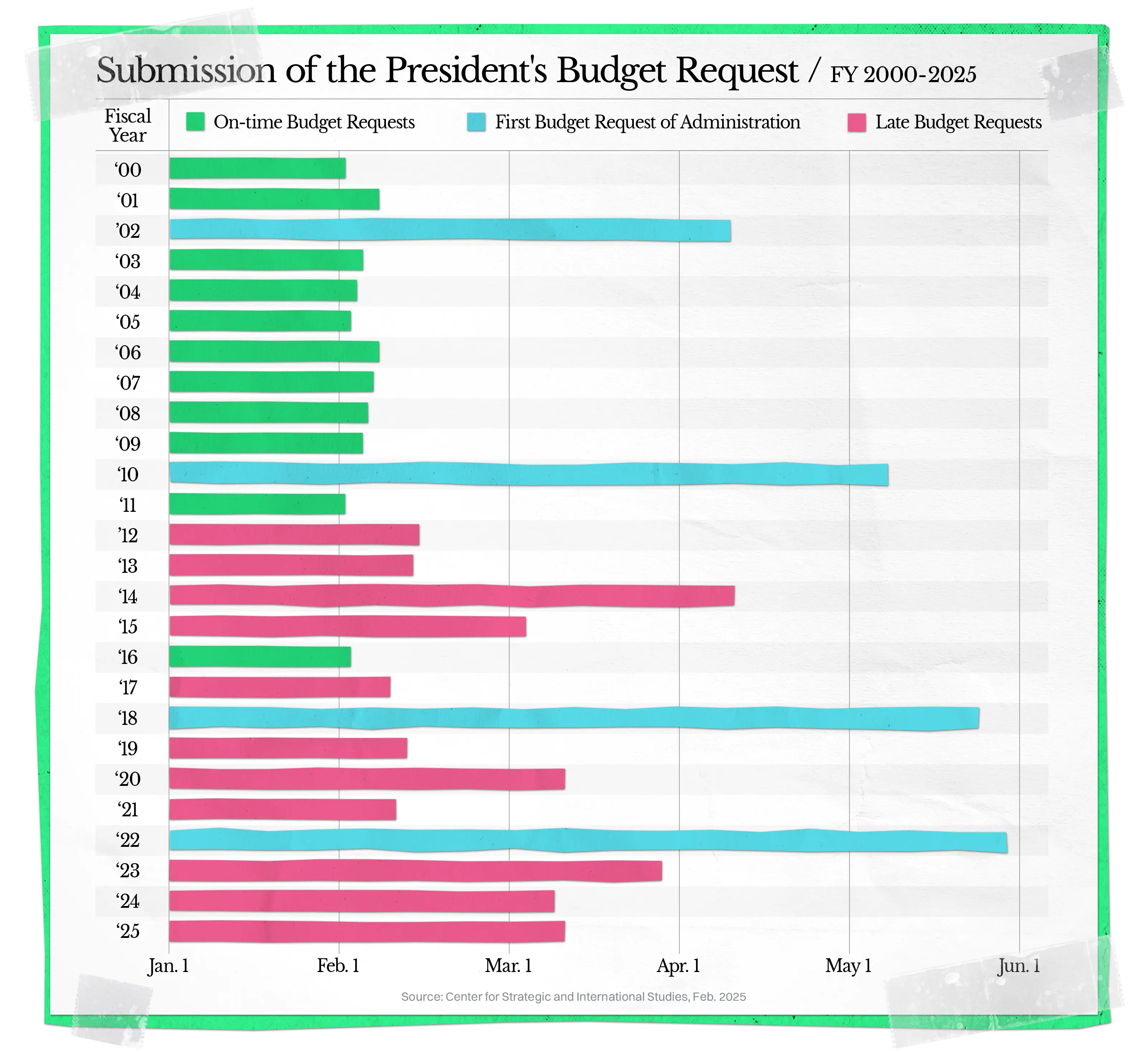
The reason for this delay often boils down to logistics. For example:
- If the previous funding process goes past October 1st — which it often does — the administration has to start its new proposal late.
- If there is a change in administrations, cabinet positions, or policy priorities, the White House proposal could also be delayed.
Let’s be clear. Congress is not going to sit by for weeks waiting on guidance from the White House before it starts its own budget process. It’s going to start before the President’s Budget arrives if it has to. However, a delay from the president could result in poorer coordination with the White House, more conflict, or a greater chance of having to redo the work later on.
So, as with any tight timeline, the president missing this deadline causes the whole budget and appropriations process to lag.
The Budget Resolution is Late or Missing
Even without the President’s Budget, the House and Senate are responsible for adopting a concurrent budget resolution by April 15. As you already know, this is Congress’ game plan for spending and revenue. It’s how lawmakers in both chambers align on priorities, help the budget process run smoothly, and make it easier to pass legislation.
The problem is that the House and Senate cannot agree on what they want to accomplish, so they pass it late or not at all.
Since the April 15 deadline was established in 1986, our lawmakers have met the April 15th deadline only four times. Of the 26 budget resolutions adopted from FY 1987 to FY 2026, Congress was — on average — 80 days late.
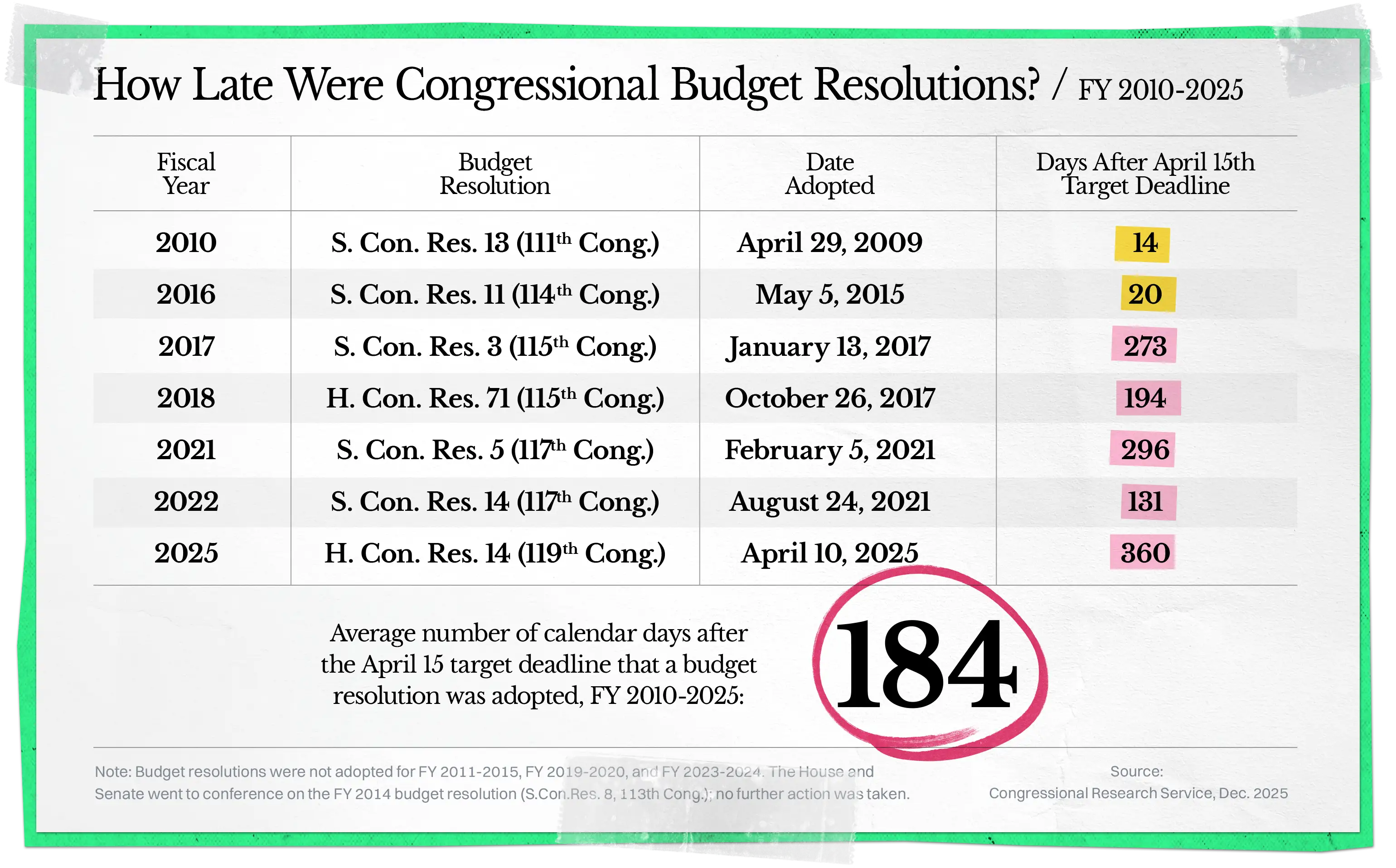
In nine of the last 16 years, the House and Senate didn’t pass a concurrent resolution at all.
How does this happen? Each chamber sidesteps the requirement to pass the same budget resolution and moves forward with different and often competing priorities.
This makes the budget and appropriations process slower, messier, and harder to accomplish.
Congress Cannot Pass Many Standalone Appropriations Bills
In a perfect world, steps 3 and 4 would work like this:
- The House and Senate Appropriations Committees and subcommittees draft and pass 12 appropriations bills covering discretionary spending.
- That legislation is debated, amended, and passed in both chambers, and the House and Senate reach a consensus on each appropriations bill before October 1st.
The House and Senate Appropriations Committees do their jobs by passing 12 appropriations bills.
Unfortunately, many of these bills cannot garner enough votes to pass either the House or Senate. Because of political or policy differences within or across parties, House and Senate leadership often aren't able to get enough votes to move many of these appropriations bills through their respective chambers.
This turns the budget and appropriations process into a true race against the clock.
Review and Debate are Often Crammed Into One or Two Bills
With a potential government shutdown looming (we will discuss that in more detail in a moment), House and Senate leadership often combine some or all of the appropriations bills into a single legislative package that they hope will appeal to the most members.
These combined bills can be thousands of pages long and arrive in the final hours before an appropriations deadline. They come in two forms:
- A “minibus” bill is a legislative appropriations package that combines some, but not all, of the 12 discretionary spending bills.
- An “omnibus” bill groups together all 12 appropriations bills.
There’s often little time for lawmakers to read them, understand them, or provide feedback.
With time ticking, these bills are sent to the House and Senate floors for passage with limited debate and amendments.
That might help get discretionary spending across the finish line, but it doesn’t mean the budget and appropriations process is working.
Congress Uses Quick Fixes to Buy More Time
In many cases, even a minibus or omnibus bill cannot garner enough votes to pass both the House and Senate. That results in Congress opting for quick fixes to America’s funding needs instead of meaningful solutions.
These temporary solutions are called continuing resolutions or stopgaps. They fund the government for a limited period of time by extending discretionary spending at the previous year’s level with minor adjustments.
Continuing resolutions do, in fact, have a purpose. They buy members time to work through backlogs, resolve their differences, and finalize the appropriations bills. If used sparingly, they can be an effective tool in an emergency.
But they are no longer just being used in emergencies.
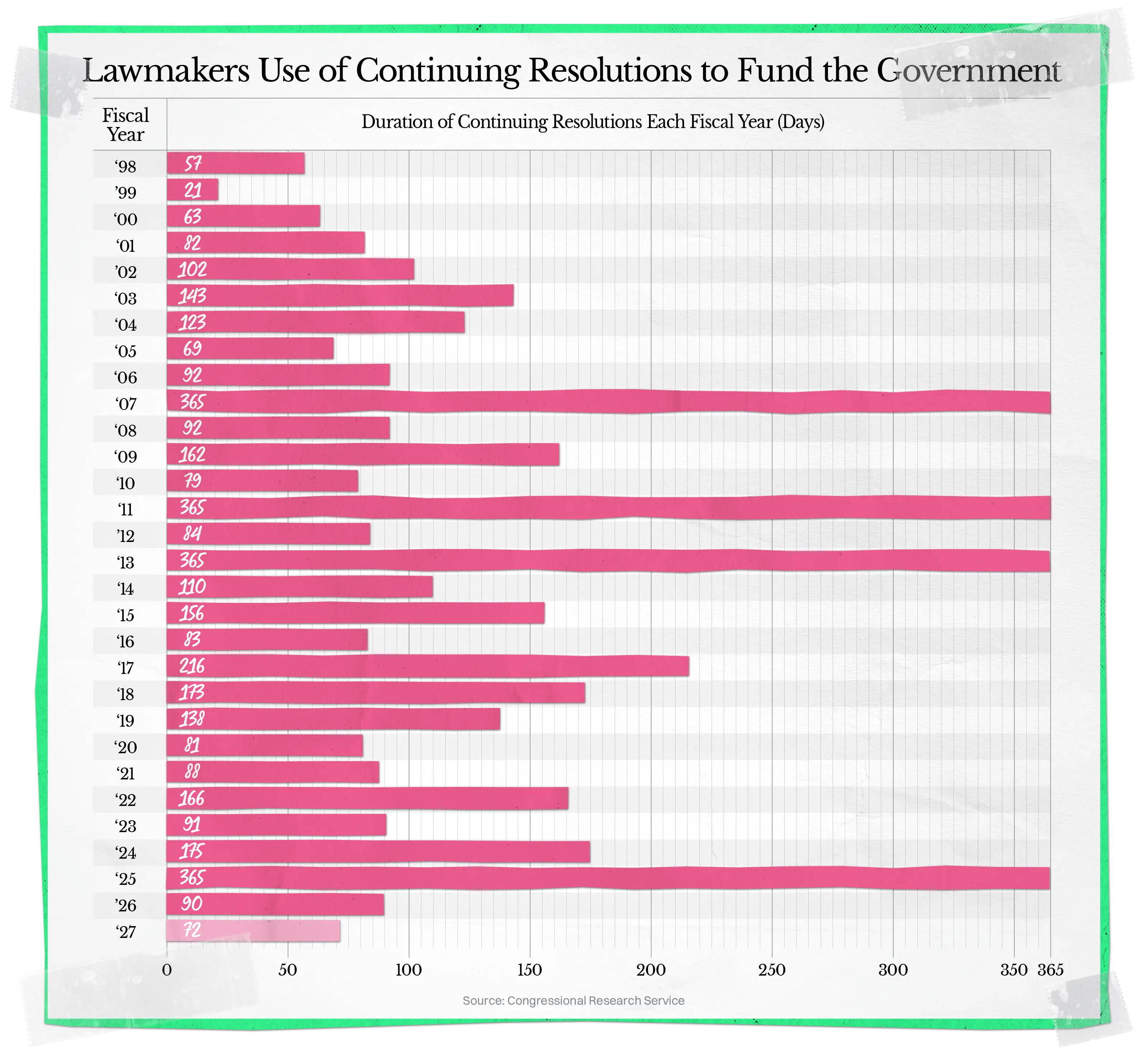
Between FY 1998 and FY 2026, lawmakers used 139 continuing resolutions with around five stopgaps annually. On average, they are in effect for around one-third of the fiscal year and in some instances, have funded the government for an entire year.
Remember when we said Step 5 involved the president having 10 days to sign a single appropriations bill? Under the current approach, he often has barely 10 minutes to sign a law keeping the entire government up and running.
CONSEQUENCES
What Happens When Nothing is Passed?
As we said earlier, if you are part of Gen Z, you have never even seen the budget and appropriations process play out on schedule… but you’re probably familiar with the term “government shutdown.”
That’s what happens when Congress fails to pass any of these types of spending measures.
Executive agencies have no option but to stop activities and services that haven’t been funded by Congress. This is called a shutdown.
If Congress has already finalized funding for some of the executive agencies by passing one or more appropriations bills, only the unfunded agencies will shut down. This is known as a partial government shutdown.
However, if no executive agency has approved funding, most federal government operations will be affected. This is known as a full government shutdown.
In a full government shutdown, all non-essential government functions halt, and federal workers are told not to report for work. Meanwhile, those providing essential services funded through appropriations bills continue to work without pay. This includes air traffic controllers, law enforcement, some immigration services, and staff managing Social Security payments. These disruptions continue until Congress passes bills funding these agencies.
Since 1981, shutdowns have become more frequent and severe, each representing a breakdown of the budget process.
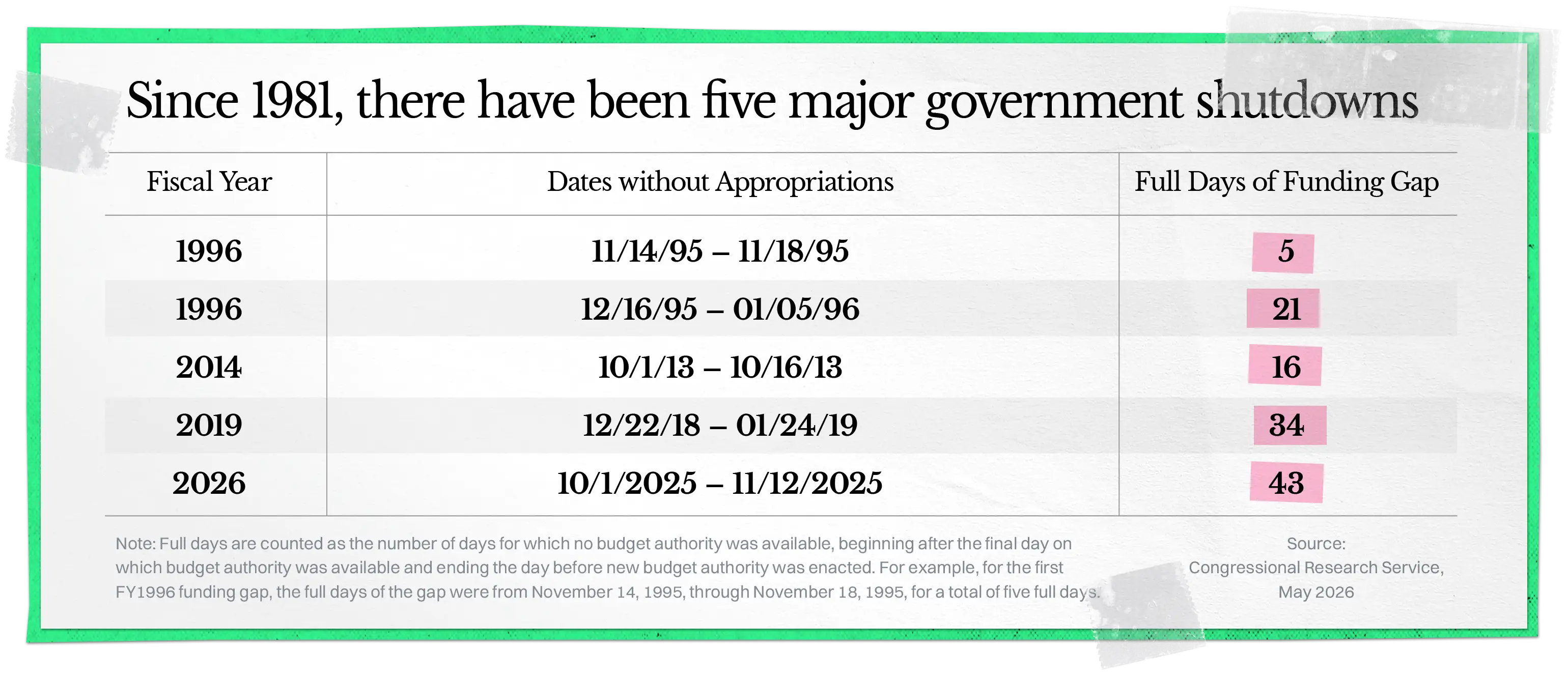
As you can see, the challenges facing the budget and appropriations process are pretty serious — serious enough to bring government programs and services to a grinding halt.
