
How It Works
So far, we’ve established that:
- Congress has “the power of the purse,” or the ability to collect revenue and determine spending.
- Revenue is how much money the federal government will take in from taxes, activities, and fees.
- Spending is how much the federal government will send out to fund mandatory obligations and discretionary programs.
- The federal budget outlines the expected revenue and spending for the year.
But how does Congress make decisions about the federal budget? The answer to that question has been centuries in the making.
The Constitution gave Congress "the power of the purse,” but it didn’t specify how the legislative branch would exercise this authority. The federal budget process evolved over time through a maze of measures, statutes, rules, precedents, and practices.

Big Moments in Budget History
The First Budget: 1789
Congress adopted the first federal budget in 1789. Short enough to read over morning tea, it took up just half a page in The Gazette of the United States newspaper.
Up until the 1920s, the federal budget was created through a fairly simple four-step process:
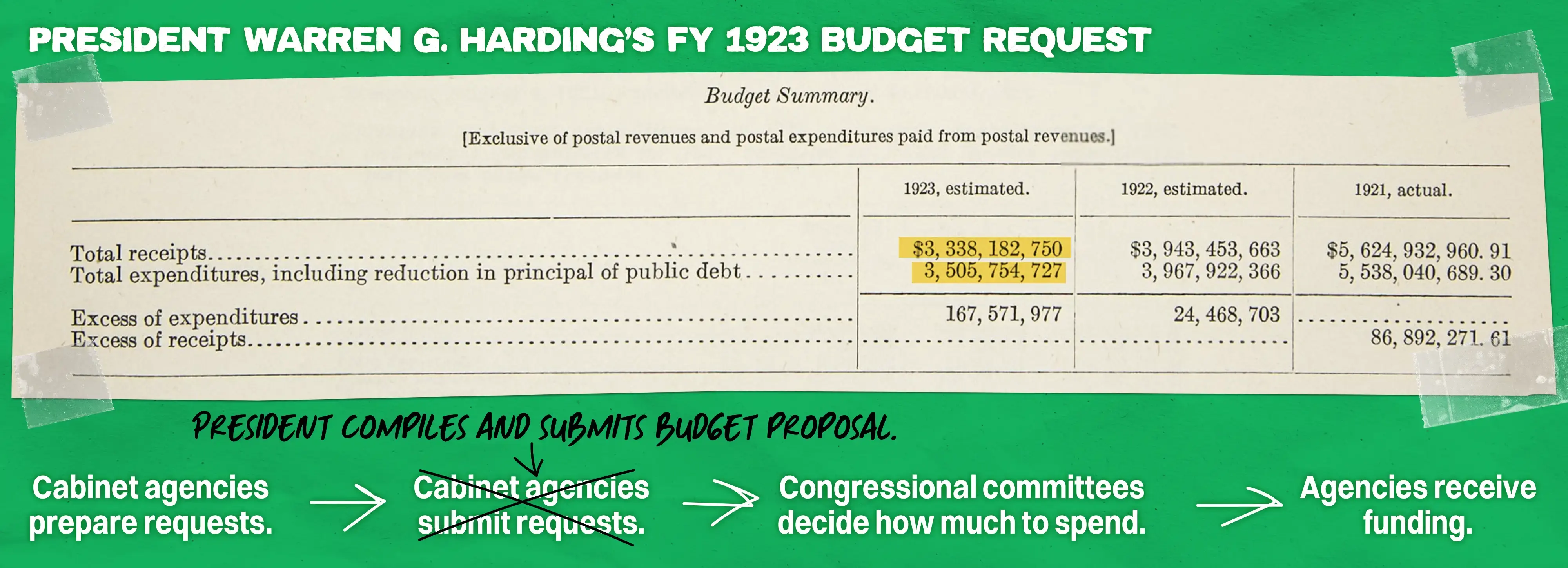
- Cabinet agencies prepared budget requests.
- The agencies submitted their requests to Congress.
- Congress — through various committees it created and dissolved over the years — used the requests to decide how much to spend each year.
- Once spending was decided, agencies received allocated funds.
The 1920s: The President Gets Involved
In 1921, Congress passed the Budget and Accounting Act, giving the president a more prominent role in managing America’s finances. Specifically, the Act made a few big changes:
- It required the president to submit an annual budget proposal to Congress (rather than having Cabinet agencies submit their own requests).
- It created the Bureau of the Budget (known today as the Office of Management and Budget, or OMB) to help the president with this task.
- It created the General Accounting Office (today known as the Government Accountability Office, or GAO) to independently audit government budgetary activities.
In December 1921, President Warren G. Harding submitted the first formal presidential budget request to Congress, detailing his overall spending and revenue goals.
The 1930s to 1960s: The Rise of Mandatory Spending
Before the Great Depression, mandatory spending was a small portion of the federal budget. However, this changed with the enactment of two key pieces of legislation:
- The Social Security Act of 1935 created Social Security and several other mandatory programs.
- The Medicare and Medicaid Act of 1965 created, you guessed it, Medicare and Medicaid.
These laws provided benefits, including cash payments, to anyone who met certain eligibility criteria.
Funding for these laws was not determined by annual congressional spending decisions. Instead, it was based on how many people met the criteria and were entitled to a payment.
Entitlement programs tend to grow over time because anyone who qualifies can receive benefits. As more people depend on them, political pressure builds to expand them.
Congress anticipated this, so it established accounting mechanisms to keep programs like Social Security and Medicare on stable financial footing. These mechanisms, known as trust funds, are meant to limit spending to available revenue. However, due to demographic changes and policy decisions, these programs have grown to a point where they now face long-term sustainability challenges.
The 1970s:
Congress Gets Its (Congressional Budget) Act (of 1974) Together
In the 1970s, two major challenges led Congress to adopt new legislation governing the budget process.
The first challenge was the president’s role in the process.
Starting in 1921, the president was required to submit a formal presidential budget request to Congress each year. As you might imagine, including the president in the process worked well when the president’s and Congress’ priorities aligned. But it created problems when they disagreed.
That’s exactly what happened in 1972. Congress approved funding for programs that President Richard Nixon opposed. His solution? He simply refused to spend the money through a process known as “impoundment.” That didn’t sit well with Congress.
The second challenge involved the congressional side of the budget process.
Simply put, it lacked any formal coordination. Budgetary measures were considered throughout the year. Sometimes they were compared against the president’s request, sometimes not.
By the 1970s, Congress was unable to effectively exercise its “power of the purse.” It didn’t have the ability to establish and enforce budgetary priorities, and it didn’t have a framework for coordinating legislative action on spending and revenue. Even worse? The president had budget-related resources that Congress didn’t. The OMB provided the executive branch with its own budgetary and economic information, but the legislative branch didn’t have the infrastructure to generate that kind of information on its own.
So, in 1974, Congress passed the Budget and Impoundment Control Act. The Act reasserted Congress’ “power of the purse” by:
- Barring presidents from sidestepping congressional funding decisions.
- Creating new legislative branch institutions to assist Congress with the budget. These include committees in the House and Senate and the Congressional Budget Office (CBO).
- Instituting a new, formal process for federal budget activities.

THE NEW BUDGET PROCESS
The 1974 Act established a fiscal year that runs from October 1st to September 30th. During this timeframe, lawmakers set revenue and spending priorities for the upcoming year (e.g., the budget process in 2026 should produce the budget for FY 2027).
The process begins with the president’s budget request.
After considering this request, Congress then drafts and adopts a concurrent resolution on the budget. This is usually referred to as the budget resolution. Passed by both the Senate and House, this concurrent resolution does not have the force of law. But, it allows Congress to set the overall fiscal policy, establish revenue and spending levels, and provide the guidelines for budget-related measures.
Those budget-related measures include the 12 annual appropriations bills, which set discretionary spending levels and specify the amount of money allocated to federal agencies and government programs.
Today, the timeline for the federal budget and appropriations process is supposed to look like this:
.webp)
BY THE NUMBERS
We’ve come a long way from that first budget in 1789.
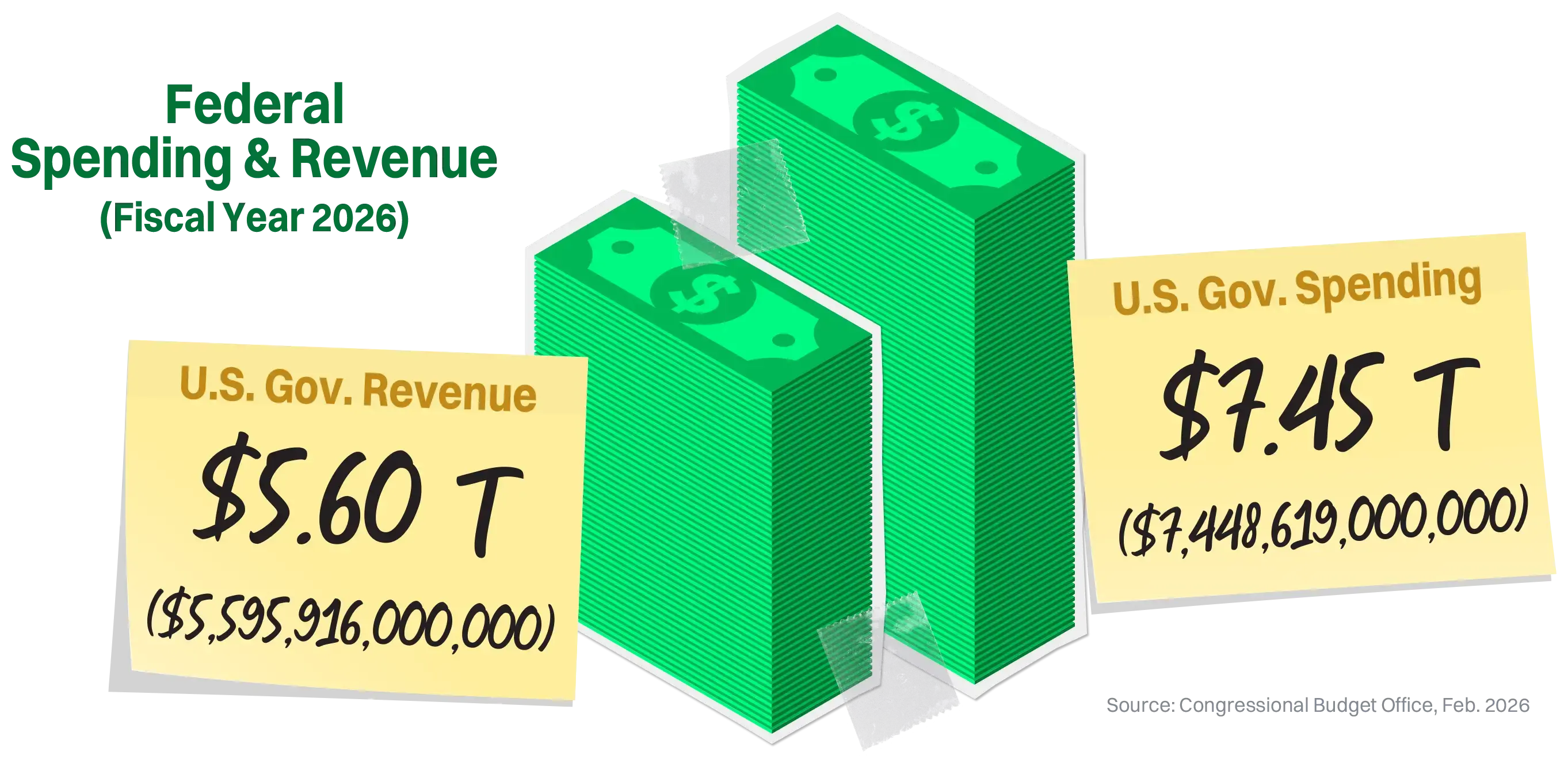
Today, the federal budget process involves the president, Congress, and a slew of government offices, congressional committees, and budgetary measures. It also involves a lot more money. In FY 2026 alone, the federal budget contains $5.60 trillion in revenue and over $7.45 trillion in spending.
As you can imagine, this impacts the length of the federal budget. In 2024, it was a light read of 866 pages long.
In other words, good luck reading it over morning tea.
