Challenges
To quickly review:
- The federal budget outlines the expected revenue and spending for the year.
- The 1974 Budget and Impoundment Act established an annual process for the federal budget. It begins with the president’s budget request, includes a congressional concurrent resolution on the budget, and ends with 12 appropriations bills signed by the president.
- Most revenue comes from taxes, and spending is divided between mandatory and discretionary programs.
As the federal budget evolved over the years, new challenges emerged. Below, we unpack the biggest three.

Challenge #1
The Process is Broken
Under “How It Works,” we discussed the phases and deadlines that the federal budget process is supposed to adhere to.
- February: Using guidance from the OMB, the president submits a budget proposal to Congress on the first Monday in February.
- March - June: The House and Senate draft and pass the concurrent resolution on the budget. The appropriations committees in each chamber (and their respective subcommittees) hold hearings and draft the 12 appropriations bills.
- July - October: The full House and Senate consider, debate, and pass the 12 appropriations bills. These bills are then sent to the president for signature.
That’s how it’s supposed to work in theory. In reality, it often doesn’t.
Here are just a few examples of pain points in the process:
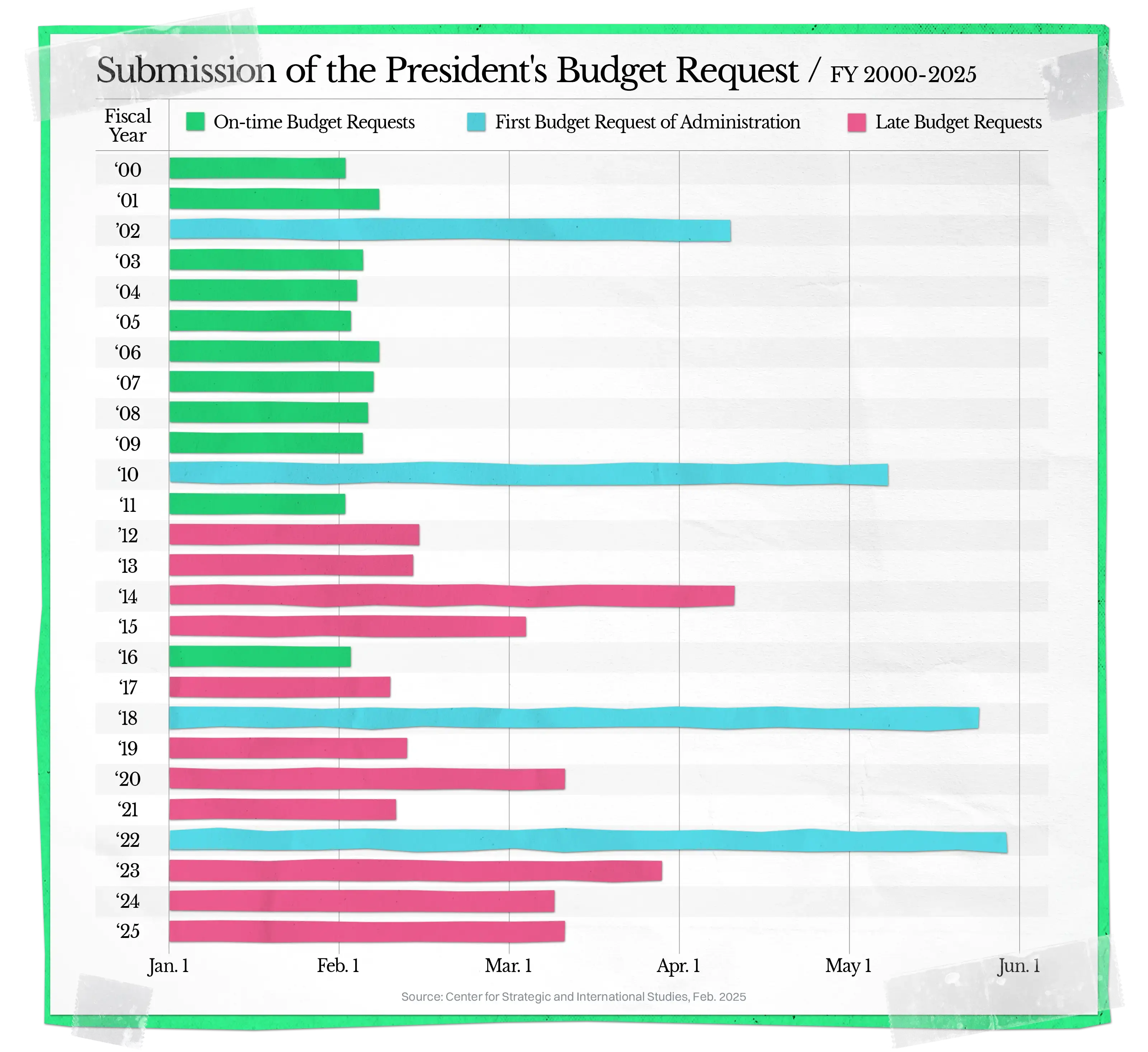
- The president often fails to submit their budget request by the first Monday in February. This is frequently an issue when transitioning from one administration to another. The chart below shows the timing of presidential budget requests since FY 2000.
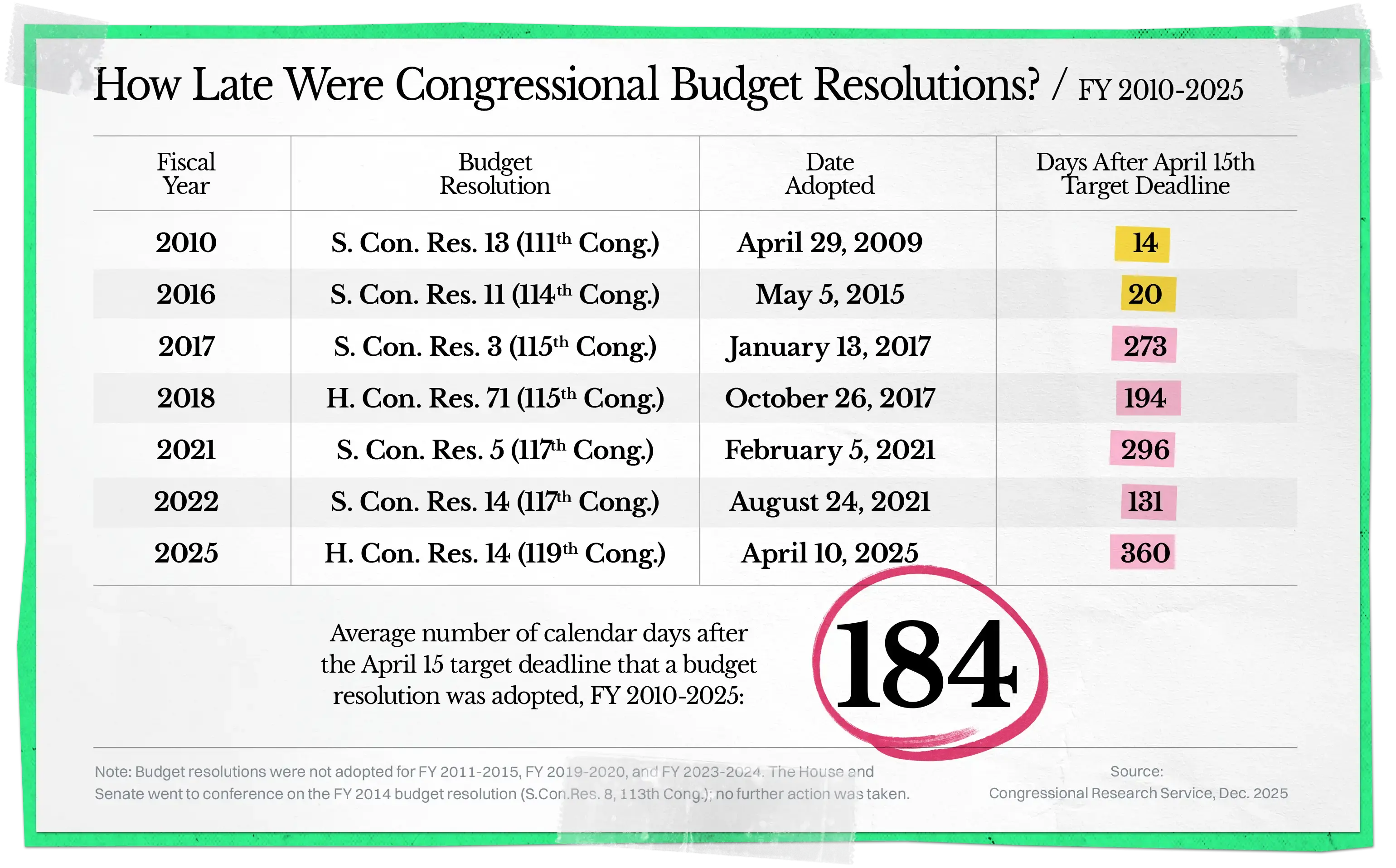
- Congress doesn’t pass its concurrent resolution on time… or at all. Since 1985, Congress has only met the April 15th deadline four times. For the 26 budget resolutions adopted from FY 1987 to FY 2025, Congress was — on average — 80 days late. In nine of the last 16 years, it didn’t pass the resolution at all.
Over the last 50 years, Congress has only met the October 1 deadline for passing all 12 appropriations bills four times.That’s right. Gen Z has never seen these bills passed on time. In fact, in 1996, the last time Congress met the October 1 deadline…
- President Bill Clinton was re-elected for a second term.
- The first “Mission: Impossible” movie debuted in theaters.
- Beanie Babies were all the rage!

When Congress misses these deadlines, lawmakers often pass temporary budget measures to keep spending at existing levels until they can agree on what to do next. If lawmakers cannot agree on a temporary budget measure, the government goes into a shutdown, like we saw in 2019, 2025, and 2026.
If that doesn’t sound like a big deal, consider this: shutdowns can lead to…
- Federal workers being furloughed, impacting their livelihood.
- Disruptions to basic government services, like assistance for families in need.
- Potential economic fallout, like a rise in unemployment, financial market instability, or business planning uncertainty.

Challenge #2
The National Debt is Growing
Whether the federal budget process is orderly and on time or a delayed, chaotic mess, one thing has remained constant in modern budgeting: We keep spending more than we take in.
Deficit spending is not inherently bad. In fact, it’s an important tool that can help the government address crises (like the Great Recession in 2008 or COVID-19 in 2020). But you should ask yourself: Is the government too reliant on deficit spending to fund its basic programs and services?
Well, it’s certainly become the norm. Except for a four-year period (FY 1998-2001), we’ve run a budget deficit every year since 1970.
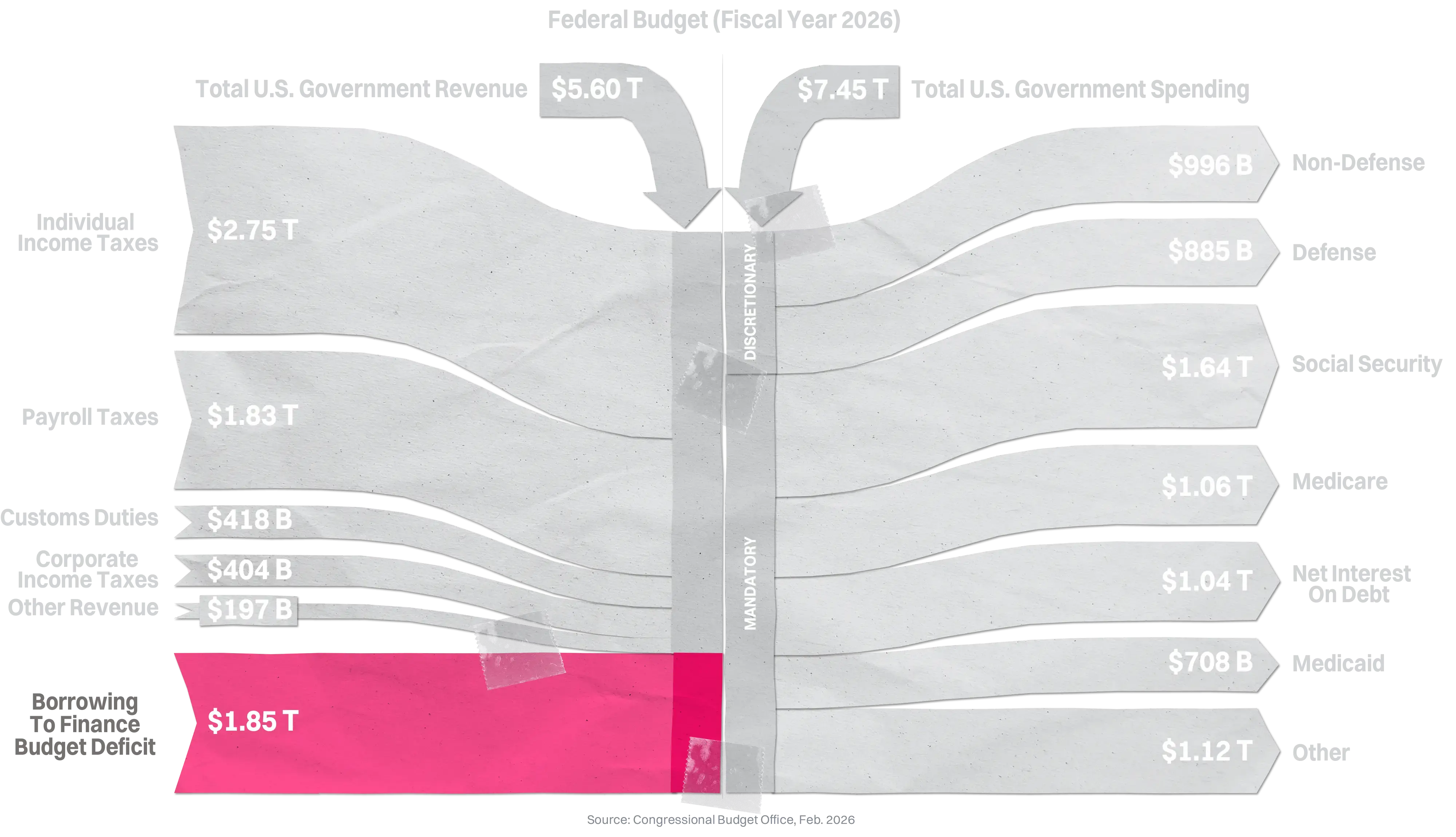
Remember, in FY 2026, we’re on track to overspend by about $1.85 trillion.
Each year we run a deficit, our national debt grows. It’s already surpassed $40 trillion and under our current spending habits, it is projected to reach $63.7 trillion in FY 2036.

Challenge #3
Mandatory Spending is Growing
One of the things that makes deficit spending so difficult to address is the growth in mandatory spending.
As a reminder, mandatory spending happens under existing law without Congress voting to spend the money every year. It includes net interest payments on our national debt and funding for entitlement programs.
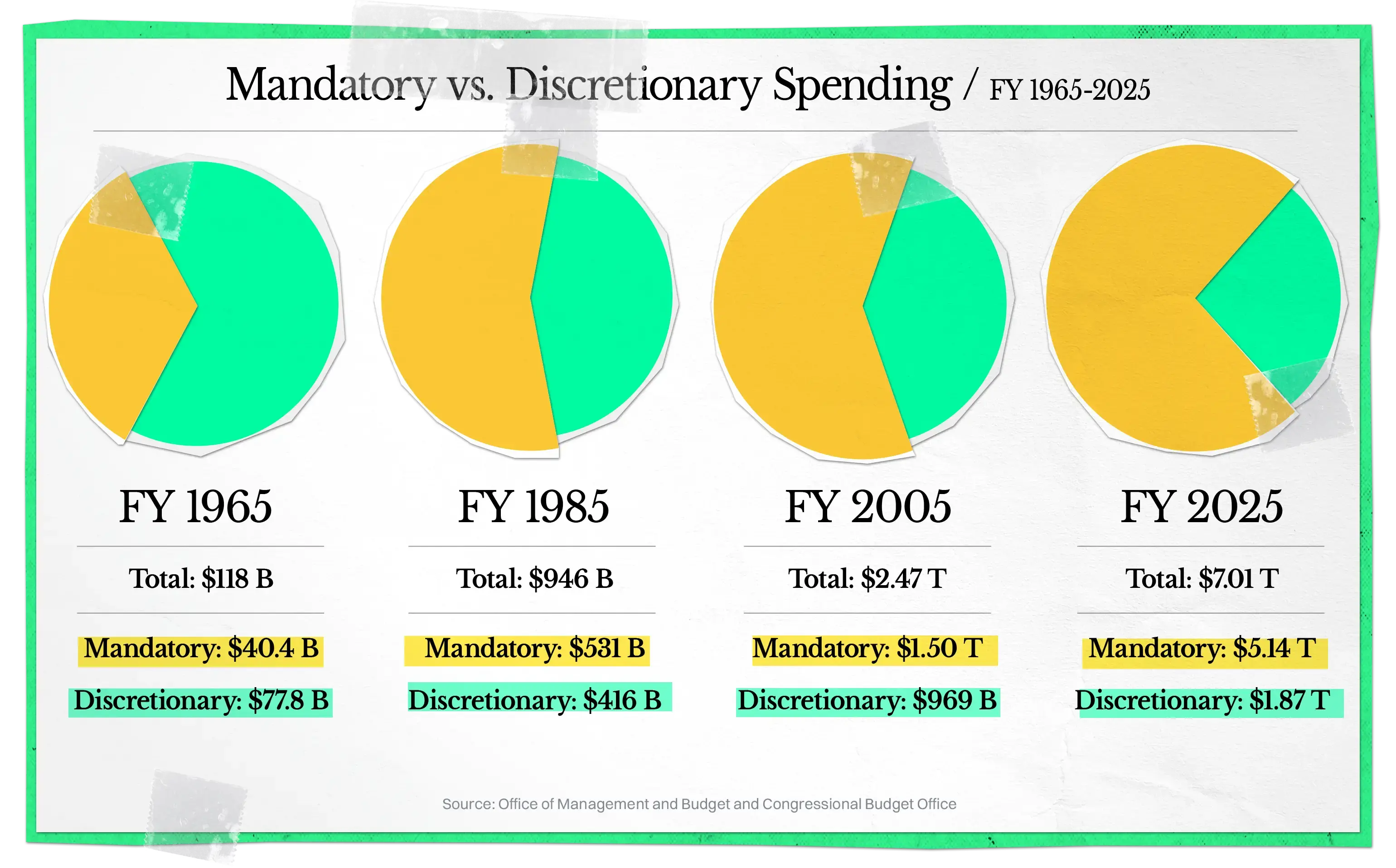
Before the mid-1970s, mandatory spending made up less than half of the federal budget. Since then, mandatory spending has grown substantially. Much of this growth has been driven by program expansion and increased enrollment in Medicare, Social Security, and Medicaid.
Below, you can see how mandatory spending has slowly consumed a greater and greater portion of the budget, effectively eating into discretionary spending. We call this “The Pac-Man Effect.”